
Digital dentistry has ceased to be a promise of the future to become the present for the most advanced laboratories and clinics. In this high-tech ecosystem, 3D printing stands as a fundamental pillar, and the success of each job depends directly on the chosen material. That is why, in April 2026, the conversation revolves around the best biocompatible dental resins for 3D printing, materials that not only offer exceptional precision, but also guarantee the safety and well-being of the patient.
As a digital laboratory specializing in the CAD/CAM and Exocad ecosystem, at Prodecad we understand that choosing the right resin is a critical decision that impacts workflow efficiency, restoration quality, and, most importantly, patient health. In this comprehensive guide, we will break down everything you need to know to navigate the biocompatible resin market in 2026 and make the most informed decisions for your laboratory.
What are biocompatible dental resins and why are they crucial in digital dentistry?
Dental resins for 3D printing are photopolymerizable materials, which means they solidify layer by layer when exposed to a light source (UV or LED) in an SLA, DLP, or LCD technology 3D printer. This technology allows for the creation of three-dimensional objects with astonishing fidelity and detail, from a study model to a final crown. (Source: Dental resins for 3d printers types and uses – Bracket 360).
However, not all resins are the same. The term «biocompatible» is what makes the fundamental difference in the clinical field. A biocompatible resin is a photopolymer specifically formulated to be safe in direct or indirect contact with the human body. This implies that, once properly cured, the material should not cause adverse reactions such as toxicity, irritation, or allergies. (Source: Biocompatible Resin for 3D Printing: What it is and What it is for…).
The importance of biocompatibility in 3D dental materials
Consider the difference between a plastic prototype and a dental implant. While the former only needs to fulfil a mechanical function outside the body, the latter must coexist with living tissue safely and stably over the long term. Biocompatibility is not a marketing feature; it is a non-negotiable clinical requirement. A biocompatible material has passed rigorous testing demonstrating that:
- It is not cytotoxic: It does not kill or damage the human cells with which it comes into contact.
- Does not cause irritation: Does not cause inflammation of the skin or oral mucosa.
- It is not a sensitizer: Does not trigger allergic responses in the patient.
Using a non-certified resin for an intraoral application exposes both the patient to health risks and the professional to serious liabilities. Therefore, understanding the certifications and choosing the right material for each application is the first step towards excellence in 3D dentistry.
Types of Biocompatible Resins for Dental Applications
The 2026 market offers a wide range of biocompatible resins, each formulated with specific mechanical and aesthetic properties for different clinical applications. The key is to select the resin that is not only safe but also offers optimal performance for the job at hand.
Resins for models and surgical guides
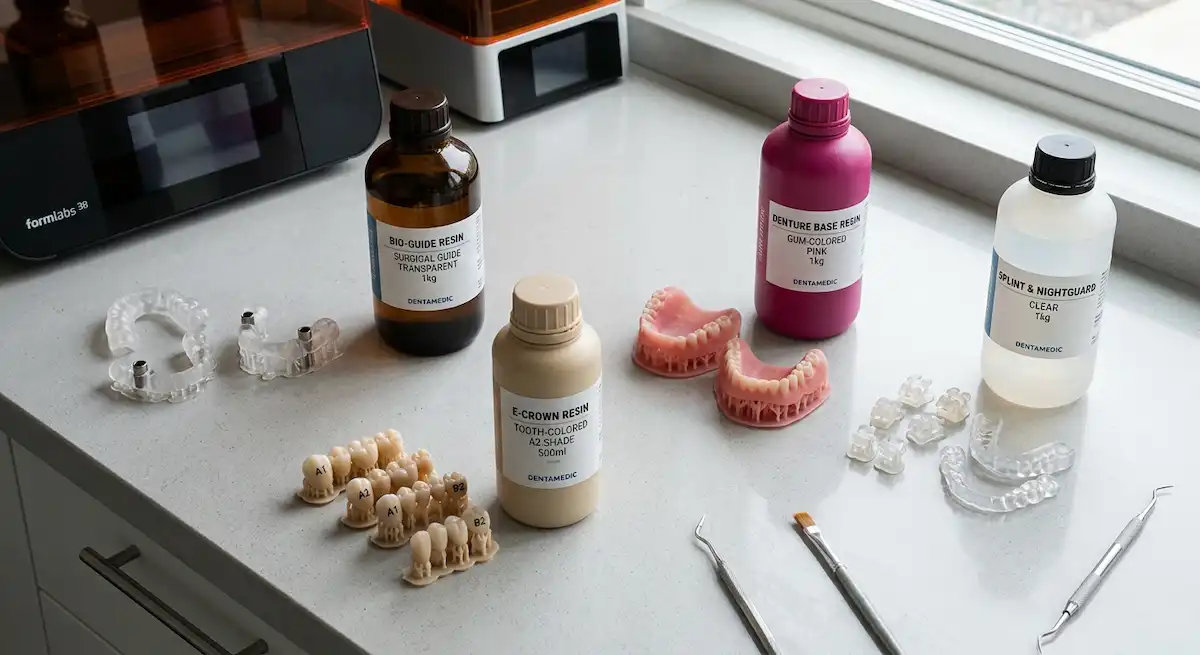
Although study models do not usually require biocompatibility (as they do not come into prolonged contact with the patient), surgical guides do. These resins must be extremely dimensionally accurate, rigid to prevent any deformation during the procedure, and often transparent or translucent to improve visibility. Biocompatibility is crucial, as they will be in contact with open tissue and fluids during surgery.
Resins for temporary restorations
Here, aesthetics begin to play a leading role. Resins for temporary crowns and bridges must offer a good range of colors (VITA guide), excellent wear and fracture resistance to withstand masticatory forces for weeks or months, and a polishable surface for good hygiene and patient comfort. They must be certified as biocompatible for medium-term intraoral use.
Resins for definitive restorations (crowns, bridges, inlays/onlays)
This is one of the most innovative fields in 2025-2026. Resins for definitive restorations are high-performance composite materials, often with ceramic fillers, that seek to emulate the properties of enamel and dentin. They require exceptionally high flexural and wear resistance, long-term color stability, and, of course, biocompatibility certifications for permanence in the mouth. The aesthetics of these restorations largely depend on a precise design, where the use of high-quality dental anatomy libraries becomes indispensable.
Resins for orthodontic splints and occlusal guards
The main characteristic of these resins is their toughness and fracture resistance. They must be able to withstand nocturnal occlusal forces (bruxism) or impacts. Transparency and resistance to yellowing are also important factors. Biocompatibility is mandatory, as the patient will wear the device for many hours, often while sleeping.
Resins for denture bases and artificial teeth
3D printing of complete or partial dentures requires two types of biocompatible resin: a pink and opaque one for the denture base, which must be impact-resistant and have low water absorption, and another in tooth shades for the artificial teeth, which must be highly wear-resistant and aesthetically pleasing. The chemical bond between the two is a key factor to consider.
Key Factors for Choosing the Best Resins in 2026
With so many options available, how do you decide which is the best biocompatible resin for your laboratory? The choice goes beyond price or brand; it is a technical evaluation based on four fundamental pillars.
Certifications and regulations (ISO 10993, CE Medical Device)
This is the most important and non-negotiable factor. A biocompatible material must have the documentation to back it up. Always look for resins that comply with recognized international standards:
- ISO 10993: It is the gold standard for the «Biological evaluation of medical devices». It defines a series of tests to evaluate the interaction of a material with the body. The most relevant for dentistry are the ISO 10993-5 (cytotoxicity) and the ISO 10993-10 (skin irritation and sensitization). (Source: Biocompatible Resin for 3D Printing: What It Is and What It's For…).
- CE Medical Device: The CE mark indicates that the product complies with the European Union's requirements for medical devices. Depending on the application, resins are classified into different classes (Class I, IIa, IIb), which determines the level of risk and regulatory requirements. For example, a resin for a permanent restoration (Class IIa) requires a much stricter assessment than one for a study model.
- USP Class VI: Although more common in the pharmaceutical sector, this certification from the United States Pharmacopeia is also an indicator of high biocompatibility.
Always demand from the manufacturer the Declaration of Conformity and the technical and safety data sheets (TDS/SDS) that prove these certifications.
Mechanical and aesthetic properties (strength, hardness, color)
Each application has its own demands. Evaluate the key properties on the material's technical data sheet:
- Flexural strength (MPa): Indicates how much the material can bend before breaking. It is crucial for crowns, bridges, and splints.
- Flexural modulus (GPa): Measures the stiffness of the material. A surgical guide needs a high modulus (very rigid), while a denture base may need some flexibility to prevent fractures.
- Hardness (Shore D): Measures resistance to indentation. Important for wear resistance on occlusal surfaces.
- Water absorption: Low absorption is vital for dimensional stability and to prevent long-term material degradation and staining.
- Color stability and translucency: For aesthetic restorations, the resin's ability to maintain its color and mimic the optics of a natural tooth is fundamental.
Compatibility with 3D printers and workflow
Not all resins work on all printers. It is essential to verify compatibility. (Source: What are the best resins for 3D printing? – Liqcreate). Reputable manufacturers provide validated printing profiles for the most common dental 3D printers on the market. Using a resin in a non-validated printer is a risk, as the printing parameters (exposure time, light intensity) directly affect the final properties of the material and its biocompatibility.
A validated digital workflow means that the manufacturer has tested and certified the combination of printer, resin, and post-curing unit to ensure that the final part meets the declared specifications. This is especially critical for medical devices.
Ease of post-processing and finishing
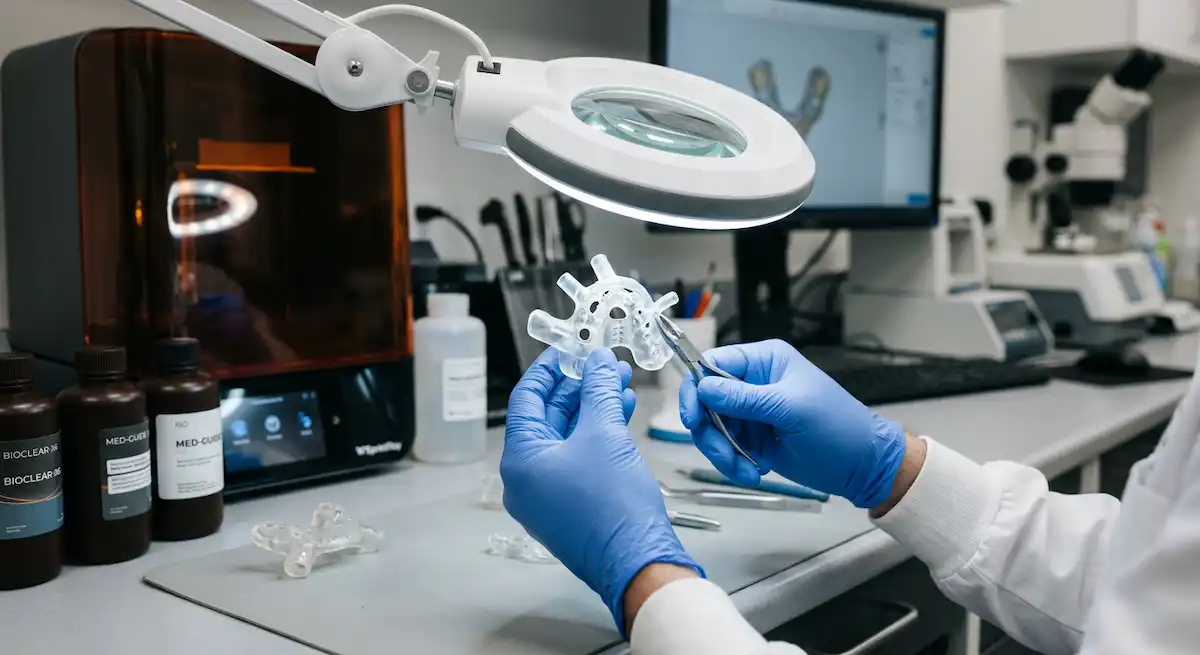
The work doesn't end when the printing is finished. The ease with which the part can be cleaned (removing uncured resin), polished, and, if necessary, stained, directly affects the lab's productivity. Some newer resins are designed for faster and simpler post-processing, which reduces labor time and improves profitability.
Featured Brands and Products for Biocompatible Resins (2026)
The dental resin market in 2026 is highly competitive and constantly evolving. Rather than recommending a single "best" product, it is more useful to understand the categories and key players so you can make your own informed assessment. The industry leaders are characterized by their strong investment in R&D, an extensive portfolio of materials for various applications, and, above all, impeccable regulatory documentation.
Comparison of the main options on the market
When evaluating different brands, don't just focus on the price per liter. Consider the total cost of the workflow. A more expensive resin with faster post-processing or a higher print success rate can be more cost-effective in the long run. As of April 2026, we recommend creating a comparison table for your most common applications, evaluating the following points for each candidate resin:
- Main application: Is it designed and certified for guides, provisionals, splints, etc.?
- Certifications: Does it have ISO 10993 and CE marking for the corresponding medical device class?
- Key mechanical properties: Directly compare the values for flexural strength, modulus, and hardness.
- Printer compatibility: Is there a validated profile for your equipment?
- Post-curing requirements: What curing unit is needed? What is the cycle time and temperature?
- Color range and aesthetics: Does it offer the shades you need for your restorations?
- Technical support and training: Does the supplier offer good support in case of problems?
Reviews and recommendations for specific uses
- For surgical guides: Prioritize rigidity (high flexural modulus) and dimensional accuracy. Transparency is a plus.
- For occlusal splints: Look for maximum toughness and fracture resistance. Transparency and resistance to yellowing are key for patient acceptance.
- For long-term provisionals: Wear resistance and color stability are fundamental. A good initial aesthetic is useless if it degrades in a few weeks.
- For definitive restorations: This is where the properties must be outstanding in all aspects: strength, aesthetics, and longevity. They are the most advanced materials and require absolute mastery of the digital workflow, from the design in Exocad to the final post-processing.
Mastering this complex process requires continuous training. Materials and techniques evolve rapidly, and staying updated is key to offering the best results.
Printing and Post-Processing with Biocompatible Resins
Buying the best biocompatible resin is only half the battle. For the final piece to be truly safe and functional, it is imperative to follow a strict printing and post-processing protocol. An error in this workflow can compromise the material's biocompatibility.
Best practices for dental 3D printing
Precision starts here. Ensure your printer is perfectly calibrated and always use the validated printing profiles provided by the resin manufacturer. The ambient temperature of the laboratory can also influence the resin's viscosity and the printing outcome, so it is important to keep it stable.
Proper cleaning, curing, and sterilization
This is the most critical step to ensure biocompatibility. Uncured resin remaining on the surface of the part is toxic.
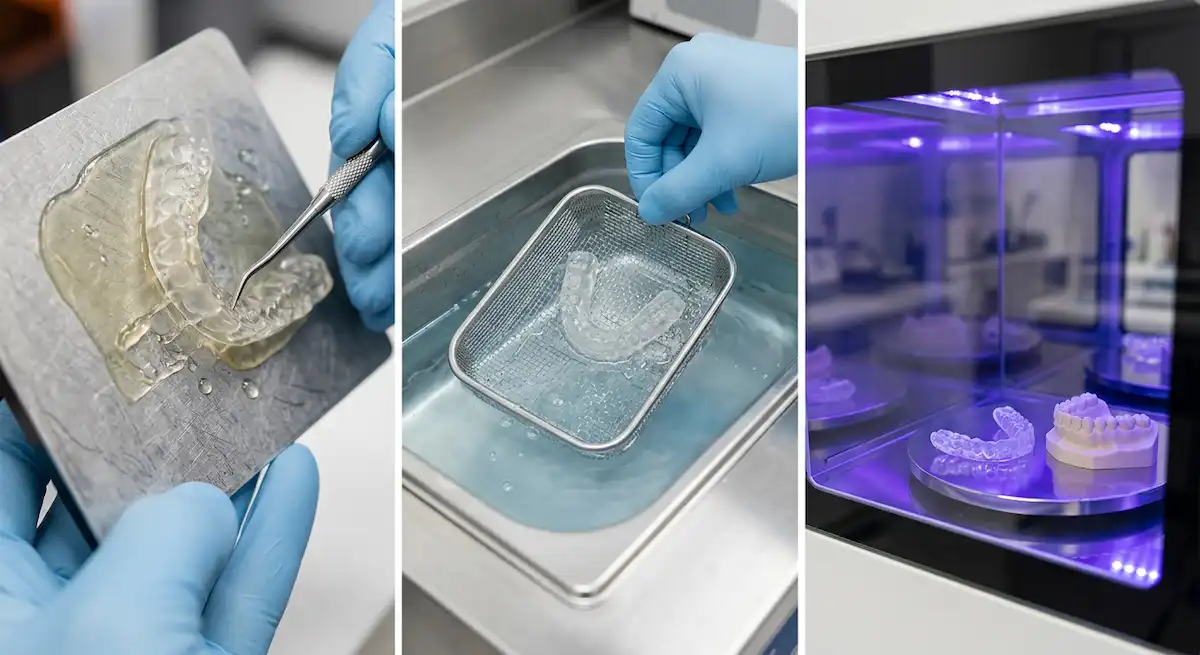
- Cleaning: The part must be washed thoroughly to remove all liquid resin residue. Isopropyl alcohol (IPA) is generally used in two successive baths (a first "dirty" bath and a second "clean" one) or automated washing systems. Follow the manufacturer's recommendations on cleaning time and method.
- Drying: Before curing, the part must be completely dry. Residual IPA on the surface can interfere with curing and affect the final properties.
- Post-curing: This is the step that finalizes polymerization and gives the material its mechanical properties and biocompatibility. Each resin requires a specific curing cycle in a suitable UV curing unit, which controls the wavelength of light, time, and sometimes temperature. Using an incorrect curing unit or an inadequate cycle will result in a part that is not biocompatible.
- Sterilization (if applicable): For applications such as surgical guides, the part must be sterilizable. Verify that the resin is compatible with autoclave sterilization methods and follow the validated protocol to avoid degrading the material.
Trends and Future of Biocompatible 3D Dental Resins
The future of 3D dental materials is incredibly promising. The trends for the rest of 2026 and beyond point towards increasingly sophisticated materials:
Innovations in materials and applications
- Resins with improved properties: We will see a new generation of resins for definitive restorations with strength and aesthetics even closer to traditional ceramics, but with the advantages of an additive process.
- Bioactive materials: Research is focused on resins that are not only inert but can have beneficial effects, such as the release of fluoride ions or antimicrobial properties to reduce the risk of secondary caries.
- Greater efficiency and automation: Manufacturers are working on resins that require shorter printing and post-processing times, integrating into increasingly automated workflows to improve laboratory productivity.
- Sustainability: The development of plant-based resins or those with a lower environmental impact is a growing trend that will likely gain importance in the coming years.
Conclusion: Optimizing your Dental Laboratory with 3D Resins
In 2026, the choice of best biocompatible dental resins for 3D printing is a strategic decision that defines the quality, safety, and efficiency of a digital dental laboratory. The key to success does not lie in finding a single magic material, but in deeply understanding the needs of each clinical application and building a validated and rigorous workflow.
Biocompatibility, supported by certifications such as ISO 10993, is the fundamental pillar. From there, the evaluation of mechanical properties, compatibility with the equipment, and meticulous post-processing guarantee predictable and safe results for the patient. Investing in high-quality materials and the continuous training of your team is the best way to stay at the forefront of digital dentistry and offer restorations that are not only aesthetic and functional, but also completely safe.
Sources
- What are the best resins for 3D printing? – Liqcreate (https://www.liqcreate.com/es/art%C3%ADculos-de-apoyo/cuales-son-las-mejores-resinas-para-impresion-3d/)
- Dental resins for 3d printers types and uses – Bracket 360 (https://bracket360.com/resinas-dentales-para-impresoras-dentales-3d/)
- Biocompatible Resin for 3D Printing: What It Is and What It's For … – Mr Resin (https://mrresin.es/blogs/mr-resin-3d-blog/resina-biocompatible-para-impresion-3-d-que-es-y-para-que-sirve)