
Digital dentistry has ceased to be a vision of the future to become the present for the most advanced clinics and laboratories. At the heart of this transformation is 3D printing, a technology that is redefining the standards of precision, efficiency, and personalization in the sector. Choosing among the best dental 3D printers is not just a purchasing decision; it is a strategic investment that can completely optimize the workflow, reduce operational costs, and elevate the quality of treatments to an unprecedented level. From creating study models to manufacturing surgical guides and biocompatible prostheses, the possibilities are immense.
At Prodecad, as specialists in the digital dental ecosystem and experts in Exocad, we understand that the transition to additive manufacturing can seem complex. That's why we have created this complete and detailed guide, based on an exhaustive analysis of the market and the real needs of professionals. Here you will not only find a ranking of the best dental 3D printers of 2026, but also the key criteria for selecting the one that best suits your clinic or laboratory, the applications that will revolutionize your daily practice, and answers to the most frequently asked questions.
Why dental 3D printers are revolutionizing dentistry
The adoption of the dental 3D printer in clinics and laboratories is not a simple technological trend, but a fundamental evolution in the way of working. This technology directly impacts efficiency, profitability, and, most importantly, the quality of patient care. The benefits are so significant that they are rapidly displacing traditional analog methods.
Greater precision: what dental 3D printers offer
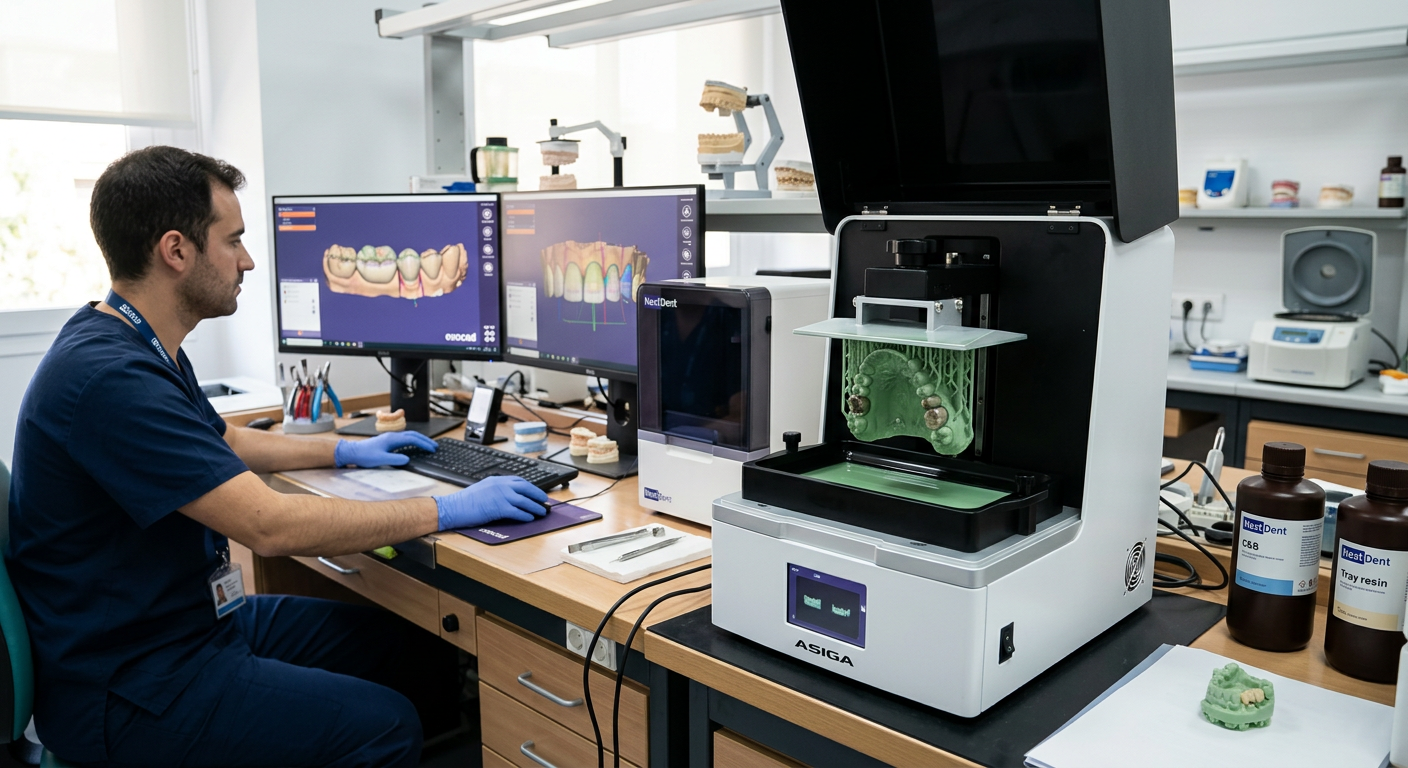
The main advantage of 3D printing is its ability to produce dental devices with micrometric precision, something unattainable with manual methods. From an intraoral scan or a CAD design in software like Exocad, the printer materializes the digital file layer by layer, replicating the patient's anatomy with absolute fidelity. This translates into prostheses, splints, and surgical guides that fit perfectly, minimizing the need for adjustments and improving clinical outcomes (Source: Which dental 3D printer to choose? Comparison of models and brands).
Time and cost reduction
The digital workflow eliminates intermediaries and waiting times. What once could take days or weeks to be manufactured in an external laboratory can now be produced in-house in a matter of hours. This agility allows for serving more patients, responding to emergencies more quickly, and reducing operational costs by internalizing production. By manufacturing the parts directly in the clinic, investment in materials is optimized and dependence on third parties is reduced, which translates into significant long-term savings (Source: Impresoras 3D dentales – Mundo Médico Dental).
Improving the patient experience
For patients, digital dentistry means the end of uncomfortable impressions with alginate or silicone. Intraoral scanning is a fast, clean, and much more comfortable process. Furthermore, the speed in manufacturing provisionals, splints, or aligners reduces the number of visits and the total duration of the treatment. Seeing their own 3D model on screen and better understanding the treatment plan also increases their confidence and acceptance, improving communication and the professional-patient relationship (Source: Impresoras 3D dentales – Mundo Médico Dental).
Ranking 2026: the 10 best dental 3D printers
Selecting the 3D printer for dentistry ideal depends on the specific needs of each professional, whether for a clinic starting with the digital workflow or for a high-volume laboratory. Below, we present a comparison of the most outstanding models on the market, classified by their main strength.
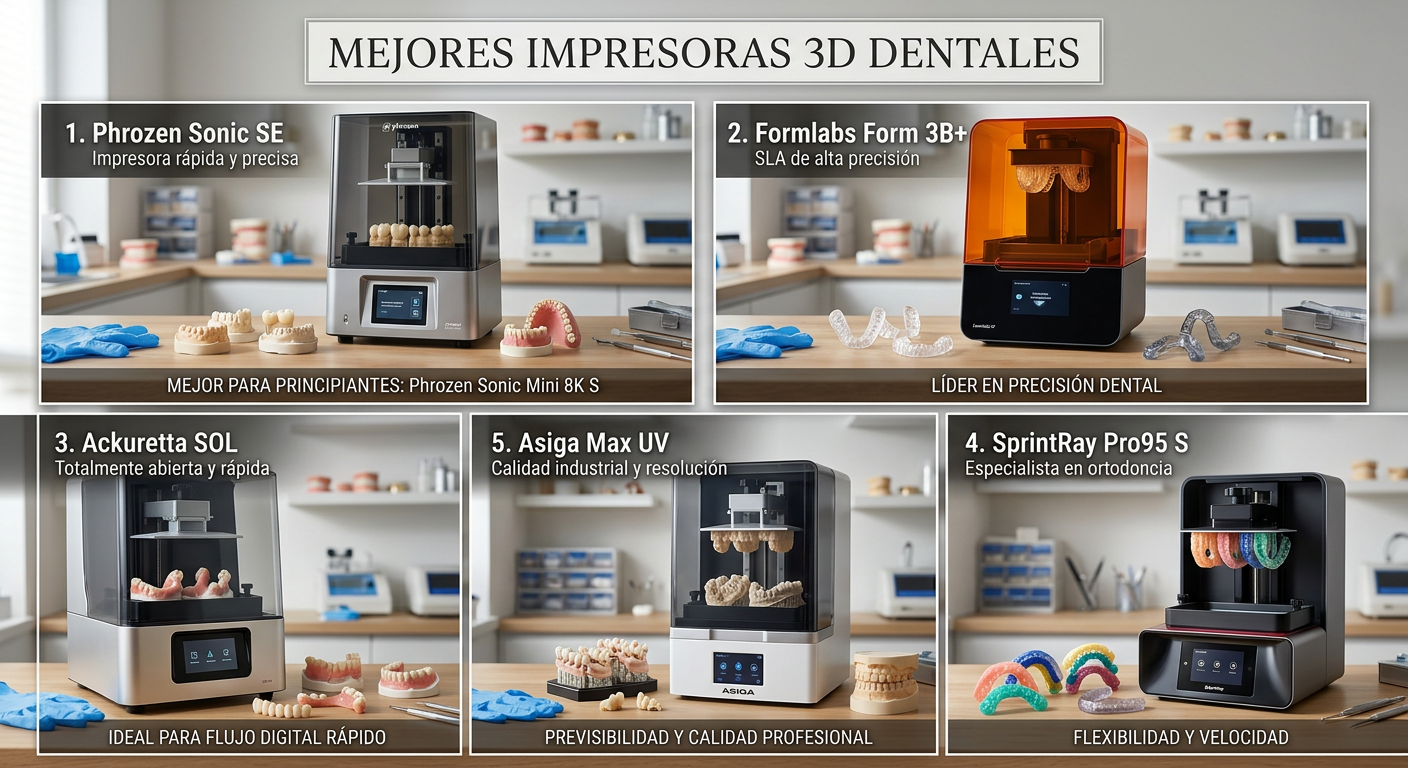
Best for beginners: Phrozen Sonic Mini 8K S
Considered one of the perfect options for those starting out in dental 3D printing. The Phrozen Sonic Mini 8K S offers an exceptional resolution of 22 micrometers (8K), which guarantees models and parts with extremely high detail. Its ease of use and a smooth learning curve make it the ideal gateway into the world of additive manufacturing without sacrificing professional quality. It is a popular choice for clinics that want to start printing study models, dies, and surgical guides without a large initial investment (Source: 🔝 What is the BEST RESIN 3D printer for DENTISTRY?).
Best value for money: Elegoo Mars 4
The Elegoo Mars 4 has positioned itself as one of the most affordable and efficient options on the market. It offers surprising print quality for its price range, being a reliable work tool for applications that do not require biocompatibility, such as orthodontic models, diagnostic models, and mockups. Its popularity in the 3D printing community ensures a large number of available resources and printing profiles, facilitating its calibration and daily use (Source: 🔝 What is the BEST RESIN 3D printer for DENTISTRY?).
Best for labs (high volume): Formlabs Form 4B
Formlabs is a benchmark in the dental sector, and its new Form 4B is specifically designed for high-production environments. Using its Low Force Stereolithography (LFS) technology, this printer not only offers impeccable accuracy and surface finish but also a printing speed up to 5 times faster than its predecessors. Its closed ecosystem, with validated materials and intuitive software (PreForm), ensures consistent and reliable results, which is crucial for labs that must comply with strict regulations and deliver top-quality work (Source: How to choose a 3D printer for your clinic or dental lab).
Best for aligners: Asiga MAX
The Asiga MAX is a professional dental 3D printer known for its precision and reliability, being a favorite for the mass production of clear aligners. Its SPS™ (Smart-Positioning-System) technology ensures a precise layer height in every print, which is vital for the sequential accuracy of the aligners. Additionally, its open material system allows labs to use third-party resins, optimizing production costs without compromising quality. It is a robust machine, designed for continuous work (Source: The best dental 3D printers for clinics).
Best for biomaterials: Anycubic Photon D2
When it comes to printing biocompatible materials for intraoral applications (splints, surgical guides, temporary crowns), the DLP (Digital Light Processing) technology of the Anycubic Photon D2 offers significant advantages. Its projector has a much longer lifespan (up to 20,000 hours) compared to LCD screens, and the light it emits is more uniform, resulting in greater accuracy and reliability in curing biocompatible resins. It is the ideal choice for professionals who prioritize durability and quality in clinical applications (Source: Best Affordable Dental 3D Printers 2024).
5 other dental 3D printers to consider:
- SprintRay Pro S (Pro55 S / Pro95 S): Known for their incredible speed and a complete ecosystem (printer, washing, and curing) designed to optimize the clinical workflow (Source: The best dental 3D printers for clinics).
- Dentsply Sirona Primeprint: Una solución “todo en uno” que automatiza gran parte del proceso, desde la impresión hasta el post-procesado, ideal para clínicas que buscan la máxima simplicidad y seguridad (Fuente: Las mejores impresoras 3D dentales para clínicas).
- Anycubic Photon Mono M5S Pro: An excellent option for labs looking for a good balance between print volume, speed, and cost, allowing for the efficient production of multiple models simultaneously (Source: 🔝 What is the BEST RESIN 3D printer for DENTISTRY?).
- Phrozen Sonic XL 4K: It stands out for its large build volume and high resolution, making it very versatile for both printing large full-arch models and producing multiple small parts at once (Source: Dental 3D Printers – Mundo Médico Dental).
- Flashforge Hunter: A DLP printer that offers a good price-performance ratio, suitable for clinics or small labs that need precision for applications like model casting (Source: Best 3D Printer for dentistry to buy in 2026 – Bimedis).
Buyer's guide: how to choose among dental 3D printers
The purchase decision for a dental 3D printer goes far beyond technical specifications. It requires a strategic analysis of your practice's current and future needs. Considering the following factors will help you make a smart and profitable investment.
Precision and resolution of dental 3D printers: what do you really need?
Accuracy is, without a doubt, the most critical factor in dentistry. It is measured in micrometers (µm) and determines the level of detail the printer can reproduce. A high XY resolution (e.g., 22-50 µm) is essential for applications such as models for crowns and bridges, surgical guides, or dies. However, not all applications require the maximum resolution. It is vital to evaluate what type of jobs you will perform most frequently so you don't overpay for precision you don't need.
How much dental 3D printers produce: volume and speed
El volumen de impresión se refiere al tamaño máximo de la plataforma de construcción y determina cuántas piezas puedes imprimir en un solo lote. Un laboratorio dental con alta demanda necesitará un gran volumen para imprimir múltiples arcadas o series de alineadores simultáneamente. Una clínica, en cambio, podría priorizar la velocidad para producir una férula o una guía quirúrgica en el mismo día (“chairside”). Evalúa tu producción diaria, semanal y mensual para elegir un tamaño y una velocidad que se ajusten a tu flujo de trabajo (Fuente: Mejores Impresoras 3D Dentales Económicas 2024).
Materials ecosystem: open or closed dental 3D printers
Algunas impresoras, como las de Formlabs, operan en un ecosistema “cerrado”, lo que significa que están optimizadas para usarse con sus propias resinas. Esto garantiza resultados predecibles y validados, simplificando el proceso y asegurando la biocompatibilidad. Otras impresoras, como las de Asiga, tienen un sistema “abierto”, permitiendo el uso de resinas de diferentes fabricantes. Esto ofrece mayor flexibilidad y puede reducir los costes de los consumibles, pero requiere que el usuario calibre y valide los perfiles de impresión para cada material (Fuente: Impresoras 3D dentales – Mundo Médico Dental).
Software, ease of use, and learning curve
Una impresora 3D no es un electrodoméstico “plug and play”. Requiere un software de laminado (slicer) para preparar los archivos CAD (como los diseñados en Exocad) para la impresión. La facilidad de uso de este software, la intuición de la interfaz de la impresora y el soporte técnico disponible son cruciales. Una curva de aprendizaje pronunciada puede generar frustración y retrasar la integración de la tecnología. Considera si necesitarás formación para tu personal y qué recursos ofrece el fabricante (Fuente: Las mejores impresoras 3D dentales para clínicas).
Total cost of dental 3D printers, beyond the initial price
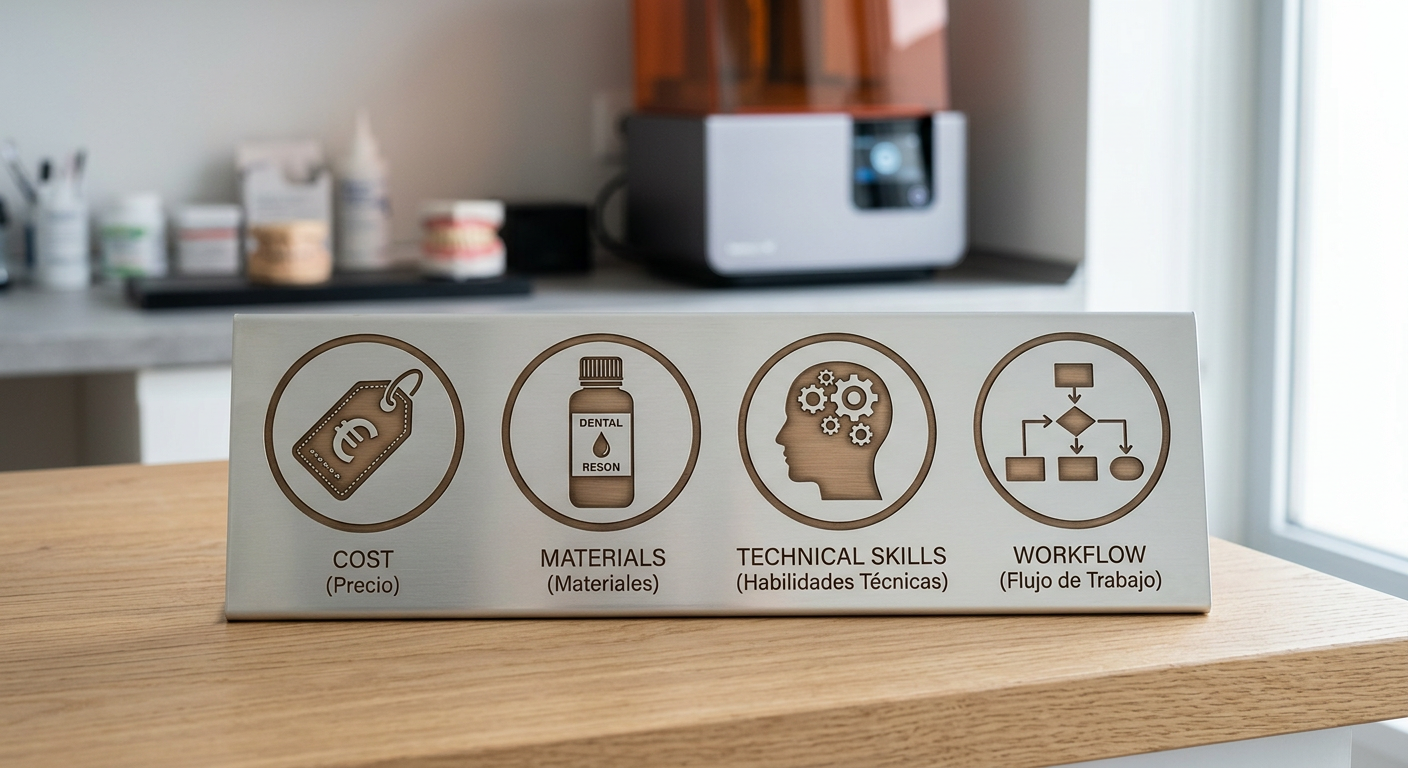
The most common mistake is to focus solely on the purchase price of the machine. The Total Cost of Ownership (TCO) is a much more realistic metric. You should include:
- Consumables: The cost of resin, tanks or vats (which have a limited lifespan), and build platforms.
- Maintenance: Possible replacements for LCD screens, DLP projectors, or mechanical components.
- Software: Some solutions may require annual licenses or subscriptions.
- Post-processing: The cost of a washing station (with isopropyl alcohol) and a UV curing station, which are essential for obtaining functional final parts.
Evaluating all these factors will give you a clear picture of the long-term investment (Source: Best Budget Dental 3D Printers 2024).
What is manufactured with dental 3D printers: most common applications
The versatility of a dental resin 3D printer allows for addressing a wide range of applications that were previously costly and slow. The ability to produce these parts in-house at the clinic or laboratory radically transforms the delivery of dental services.
High-precision models and dies
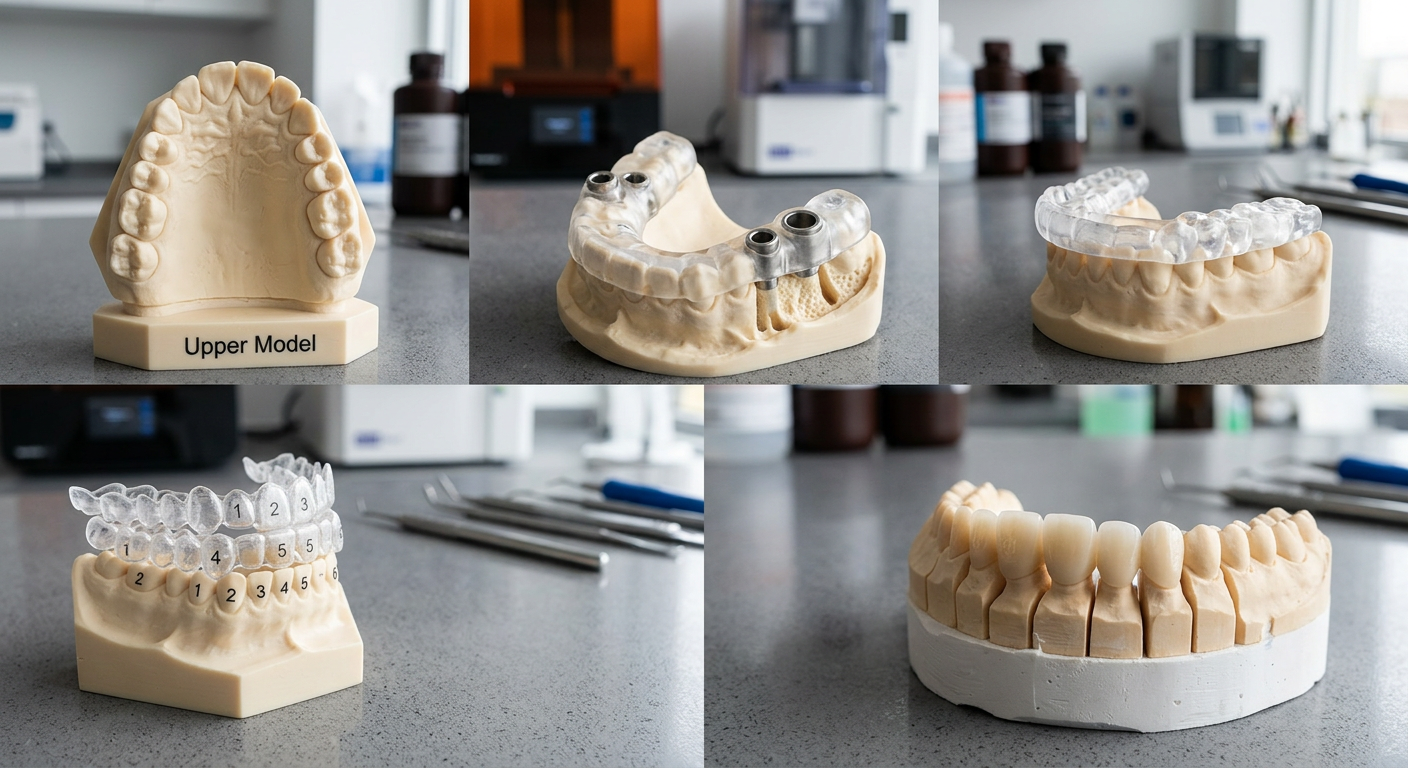
The most fundamental application is the creation of dental models from intraoral scans. These physical models are indispensable for diagnosis, treatment planning, the fabrication of retainers, and as a basis for creating restorations. 3D printing ensures an exact replica of the patient's mouth, eliminating the distortions inherent in plaster impressions (Source: Which dental 3D printer to choose? Comparison of models and brands).
Surgical guides for implants
3D printed surgical guides are one of the most impactful applications. Designed in CAD software from a CBCT and an intraoral scan, they allow the surgeon to place implants in the exact planned position and angulation. This drastically increases the precision of the surgery, reduces time in the operating room, and minimizes potential complications, offering a safer and more predictable treatment (Source: Which dental 3D printer to choose? Comparison of models and brands).
Occlusal splints and guards
The fabrication of night guards to treat bruxism, sports mouthguards, or splints for other occlusal treatments is greatly simplified. Using biocompatible resins, custom splints can be printed in a few hours, ensuring a perfect fit and greater patient comfort. This allows for the delivery of treatment almost immediately after diagnosis (Source: Which dental 3D printer to choose? Comparison of models and brands).
Temporary crowns and bridges
With modern dental resins, it is possible to print temporary crowns and bridges directly in the clinic. These temporaries have excellent aesthetics and strength, and can be manufactured while the patient waits. This eliminates the need for a second appointment for the placement of temporaries and greatly improves the efficiency of the workflow for restorations.
Production of transparent aligners
Invisible orthodontics is a field that has been revolutionized by 3D printing. Laboratories and clinics can print the complete series of models on which the clear aligners will be thermoformed. This allows for total control over the production process, reduces costs, and speeds up the delivery times of orthodontic treatment (Source: Which dental 3D printer to choose? Comparison of models and brands).
Frequently asked questions about dental 3D printers
Addressing the most common doubts is essential for making an informed decision. Here we answer the questions that dental professionals often ask themselves before investing in a dental 3D printer.
How much do dental 3D printers cost?
The price range is very wide. Affordable, good-quality dental 3D printers to start with, such as the Elegoo Mars or the Phrozen Sonic Mini, can be found for under €1,000. Professional mid-range and high-end models, designed for intensive use and with validated ecosystems, such as the Formlabs Form 3B/4B or the SprintRay Pro, can range from €5,000 to over €10,000. A model like the Flashforge Hunter is in an intermediate position, with an average price of around €2,683 (Sources: Formlabs Form 3B, Best 3D printer for dentistry to buy in 2026 – Bimedis).
What type of resin should I use?
The choice of resin strictly depends on the final application. For study or diagnostic models, standard high-precision resins can be used. However, for any device that will be in contact with the patient (surgical guides, splints, temporary crowns), it is mandatory to use biocompatible dental resins that comply with the corresponding health certifications and regulations. Always ensure that the resin is validated for your printer and for the specific clinical application (Source: Best Affordable Dental 3D Printers 2024).
Is it necessary to have advanced technical knowledge?
While modern printers are increasingly easy to use, they are not devices that work with just the push of a button. Basic knowledge of the digital workflow and a learning curve are required to understand slicing software, printer calibration, and post-processing protocols (washing and curing). The key to success is training. Having trained staff or investing in online Exocad courses is fundamental to avoid common errors and get the most out of the technology (Source: 🔝 What is the BEST RESIN 3D printer for DENTISTRY?).
What does the workflow with dental 3D printers include?
A complete and optimized workflow is the key to efficiency. It generally consists of the following steps:
- Scanning: The patient's anatomy is captured using an intraoral scanner, generating a digital file (STL).
- Design (CAD): The file is imported into design software like Exocad, where the technician or dentist designs the restoration, splint, guide, etc. At Prodecad, we specialize in this step: we function as dental design center for laboratories and we also train in Exocad.
- Preparation (Slicing): El modelo 3D finalizado se exporta a un software “slicer” (como PreForm de Formlabs o Chitubox), donde se orienta, se le añaden soportes y se lamina en cientos de capas finas.
- Printing: The sliced file is sent to the 3D printer, which manufactures the part layer by layer.
- Post-processing: Once printing is complete, the part must be washed in isopropyl alcohol to remove excess uncured resin and then cured in a UV chamber to achieve its final mechanical properties and biocompatibility. This step is absolutely crucial.
Mastering each of these phases is what guarantees predictable and high-quality results. Printing is just one part of a much larger digital ecosystem.
The integration of a dental 3D printer is a decisive step towards modernization and operational excellence. The key to success lies not only in choosing the right machine, but in understanding and mastering the entire digital workflow that surrounds it, from scanning and design in Exocad to the final post-processing. This technology will allow you to offer faster, more precise, and personalized treatments, positioning your clinic or laboratory at the forefront of dentistry.
If you are ready to take the leap and need an expert partner to guide you along the way, we at Prodecad are here to help. From our high-aesthetic design services to our Exocad training academy and our exclusive 3D tooth libraries, we provide you with the tools and knowledge to make your technology investment a resounding success.
Sources
- Best Budget Dental 3D Printers 2024 – Cursos Odonto 3D
- The BEST Dental 3D PRINTER? – MikelConekta (YouTube)
- How to choose a 3D printer for your dental clinic or lab – Formlabs
- Which dental 3D printer to choose? Comparison of models and brands – DSCTandem
- Best 3D Printer for dentistry to buy in 2026 – Bimedis
- 🔝 What is the BEST RESIN 3D printer for DENTISTRY? – Cursos Odonto 3D (YouTube)
- Dental 3D printers – Mundo Médico Dental
- The best dental 3D printers for clinics – Dandy